Dental Bridges in Ventura, California
A fixed way to close a gap.
A dental bridge replaces one or more missing teeth with artificial teeth that are fixed in place. It is held by the teeth beside the gap or by dental implants, so it stays in your mouth and is not taken out for cleaning.
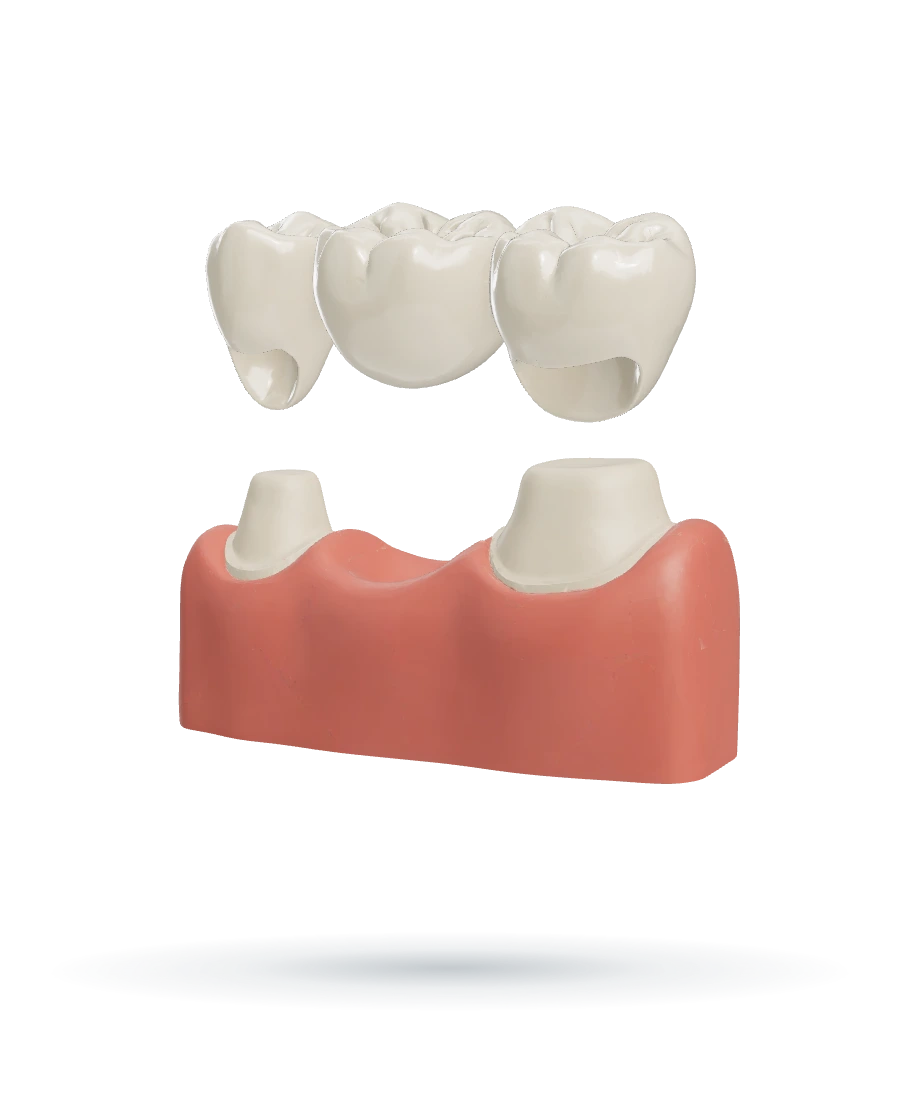
What it is
A traditional bridge has two kinds of parts. Crowns are fitted over the teeth on either side of the gap, which are called abutment teeth. One or more artificial teeth, called pontics, are joined between those crowns. The whole bridge is made as a single piece and cemented in place.
To hold a crown, each supporting tooth is reshaped, which removes some healthy enamel. That is the main trade-off of a bridge, and it is why the condition of the neighboring teeth matters when you compare options. Where several teeth in a row are missing, a bridge can sometimes be supported by dental implants instead of natural teeth.
Bridges are commonly made from porcelain fused to a metal base or from all-ceramic materials. The choice depends on where the bridge sits, how much biting force it takes and how visible it is. Your dentist will explain which materials are suitable for you at the consultation.
Potential benefits
Fixed in place
A bridge is cemented to its supports, so you do not take it out at night and it should stay steady when you eat and speak.
Keeps teeth from drifting
Teeth beside or opposite a gap can tip or shift over time. Filling the space can help keep your bite stable.
No implant surgery
A traditional bridge does not involve surgery, which can make it an option when implants are not suitable or not wanted.
Restores chewing and appearance
Replacing missing teeth can make chewing on that side easier and can fill out the look of your smile.
Who may be a candidate
A bridge may be considered when one or a few teeth in a row are missing. Whether it suits you depends on the teeth and gums around the gap.
- You are missing one or more teeth next to each other.
- The teeth beside the gap are strong enough to carry a bridge, with healthy roots and good bone support.
- The teeth beside the gap already have large fillings or crowns, which can make a bridge a more reasonable choice.
- Your gums are healthy, or gum disease has been treated first.
- You are willing to clean under the bridge every day.
What treatment typically involves
A traditional bridge usually takes at least two visits, and your own plan is confirmed at the consultation.
Examination and options
We examine the gap and the teeth around it, take X-rays and compare a bridge with other options such as an implant or a partial denture.
Preparing the supporting teeth
With the area numbed, the teeth on either side of the gap are reshaped so that crowns can fit over them.
Impression and temporary bridge
An impression of the prepared teeth and your bite is taken. A temporary bridge usually protects the teeth while the final bridge is being made.
Fitting the bridge
The temporary is removed and the final bridge is tried in. Fit, color and bite are checked and adjusted before it is cemented.
Follow-up and care
We show you how to clean under the bridge. Regular checkups let us watch the supporting teeth and the gums around them.
Recovery and aftercare
- The supporting teeth may be sensitive and the gum tender for a few days after they are prepared or the bridge is fitted.
- While you have a temporary bridge, avoid sticky and hard foods and chew carefully on that side.
- Clean under the bridge every day with the floss threader, bridge floss or small brush you were shown how to use.
- Call the office if your bite feels uneven, the bridge feels loose, or a supporting tooth becomes painful.
- Keep regular checkups so the supporting teeth and the gums around them can be checked for decay and gum disease.
What affects the cost
We do not publish a price for dental bridges, because an honest figure depends on your own mouth. These are the things it depends on.
- How many teeth the bridge replaces and how many supporting teeth it needs.
- The material chosen, such as porcelain fused to metal or all-ceramic.
- Whether the bridge is supported by natural teeth or by dental implants.
- Whether other treatment, such as an extraction or gum care, is needed first.
- What your dental insurance covers.
Questions to bring to your consultation
- Are the teeth beside my gap strong enough to support a bridge?
- How does a bridge compare with an implant or a partial denture in my case?
- How much of my healthy teeth would need to be reshaped?
- Which material do you recommend for my bridge, and why?
- How do I clean under the bridge?
- What would happen if one of the supporting teeth developed a problem later?
Common questions
How is a bridge different from a dental implant?
A bridge is supported by the teeth next to the gap, which are reshaped and crowned. An implant is placed in the jawbone and stands on its own, so the neighboring teeth are usually left untouched. Implants involve surgery and healing time. Which option suits you depends on your teeth, gums, bone and preferences.
Does getting a bridge hurt?
The teeth are numbed with local anesthetic before they are reshaped, so you should feel pressure and vibration, not pain. Some sensitivity in the supporting teeth and tenderness in the gum are common for a few days afterward. Tell us if discomfort continues or your bite feels uneven.
How long does a dental bridge last?
There is no fixed lifespan. Many bridges last for years, and how long depends largely on the health of the supporting teeth and gums. Decay at the edge of a crown and gum disease around a supporting tooth are common reasons a bridge needs replacing. Daily cleaning and regular checkups can help.
How do I clean a bridge?
Brush it as you would your other teeth. Because the artificial tooth is joined to the crowns beside it, floss cannot be passed down between them in the usual way. A floss threader, bridge floss or a small interdental brush is used to clean underneath. We will show you the technique that works for your bridge.
Can a bridge be supported by implants?
Yes, in some cases. When several teeth in a row are missing, two or more implants can carry a bridge without relying on natural teeth. This involves implant surgery and healing time first. At our office, implants are placed by Dr. Ori Levy, a board-certified periodontist. Ask at your consultation whether this applies to you.
What happens if I leave a gap unfilled?
Not every gap has to be filled, and leaving it is a choice you can discuss. Over time, neighboring teeth may tilt into the space, the opposing tooth may move, and bone in the area tends to shrink. These changes can affect your bite and make later treatment more involved. An examination can show what is likely in your case.
Related care
- Dental ImplantsA titanium post that takes the place of a missing root and supports a custom crown, bridge or denture.
- Dental CrownsA custom cap that covers a damaged or weakened tooth to restore its shape and strength.
- DenturesRemovable full or partial dentures that replace several or all of your teeth.
- Implant CrownsA custom crown attached to a dental implant to replace the visible part of a missing tooth.
- Tooth ExtractionsCareful removal of a tooth that cannot be saved, with a plan for healing and for replacing it.
Further reading
All journal articles- Dental Implant or Bridge: How to ChooseMissing one tooth? Compare a dental implant with a bridge: what each involves, how long treatment takes, how you care for it, and what to ask your dentist.
- Your Options for Replacing a Missing ToothCompare the ways to replace a missing tooth: dental implant, fixed bridge or partial denture. What each involves, how they differ and when a gap can be left.
- Dental Implants vs Dentures: How to ChooseMissing several or all of your teeth? Compare implants and dentures: how each feels, what it needs from your jaw and health, upkeep, time and cost.
- How Much Do Dental Implants Cost in Ventura?Why we give no price for a dental implant without an exam, what a treatment includes, what changes the cost, and how to compare quotes like for like.
- Your First Dental Implant ConsultationWhat happens at a first dental implant consultation: what to bring, the health questions, the exam and X-rays, how suitability is judged, and what comes next.
- Do You Need a Bone Graft Before an Implant?Not every implant needs a bone graft. Learn why bone matters, when a graft is recommended, the main types, how recovery goes and how much time it adds.
Talk it through with a dentist.
Tell us what you would like to talk about and we will reply within one business day to arrange a time.