Dental Implants in Ventura, California
A replacement that starts at the root.
An implant replaces the part of a tooth you cannot see, the root, so the part you can see has something solid to stand on. At our Ventura office, implants are placed by Dr. Ori Levy, a board-certified periodontist.
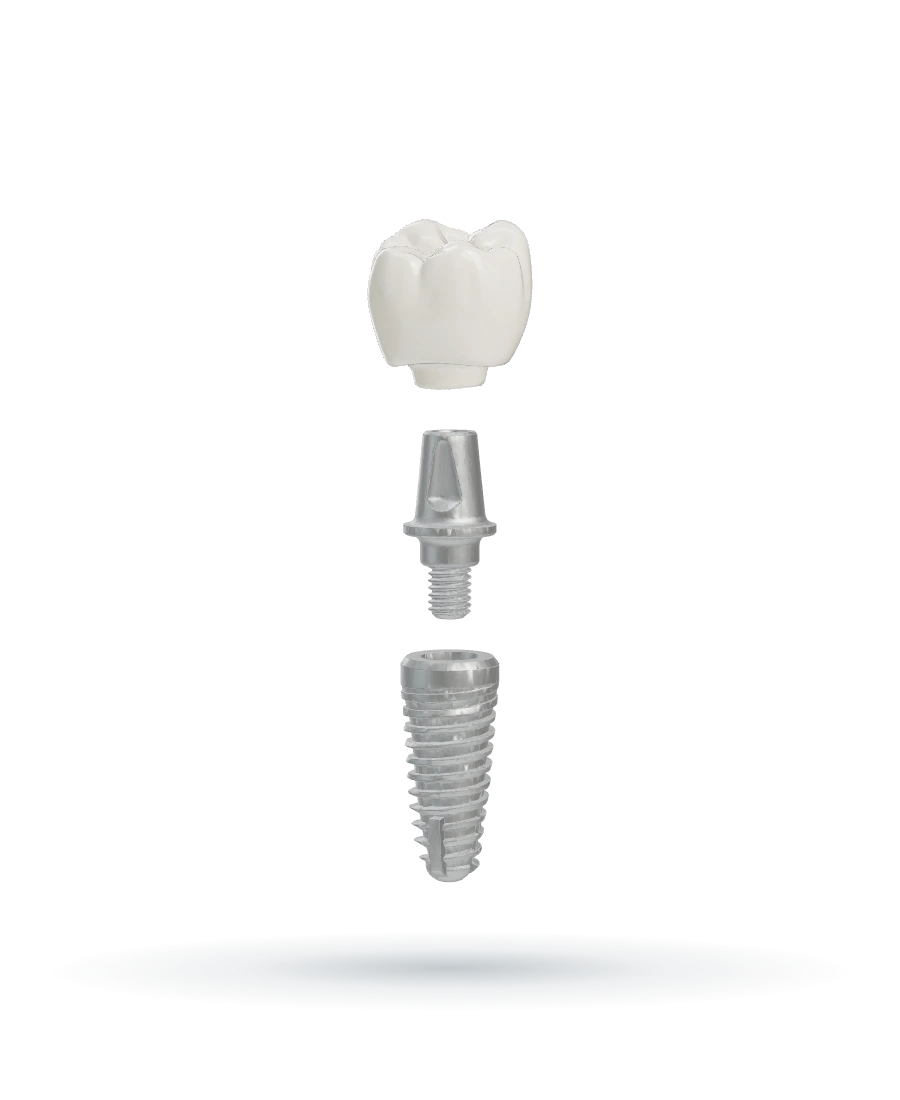
What it is
A dental implant is a small post, most often made of titanium, that is placed in the jawbone where a tooth root used to be. Over the following months the bone heals closely around it. Once that bond is stable, a connector called an abutment is attached, and a crown, bridge or denture is fixed on top.
Because the implant is anchored in bone, it does not lean on the teeth beside it. That is the main difference between an implant and a traditional bridge, and it is why implants are often discussed first when a single tooth is missing and the neighboring teeth are healthy.
Implant treatment at Dental Care of Ventura is planned in-house. Dr. Levy is a Diplomate of the American Board of Periodontology and carried out research on dental implants during his specialty training.
Potential benefits
Independent of neighboring teeth
An implant is supported by bone, so adjacent teeth usually do not need to be reshaped to hold it.
Support for the jawbone
Bone tends to shrink where a tooth is missing. An implant passes chewing forces into the jaw, which can help slow that change.
Fixed in place
A single implant crown stays in your mouth. You brush and clean around it much as you would a natural tooth.
Built for the long term
With good home care and regular checkups, many implants stay in service for decades. The crown on top may need replacing sooner because it takes the wear.
Who may be a candidate
Most healthy adults who are missing one or more teeth can be considered for implants. Whether they are right for you depends on an examination, imaging and your medical history.
- You have a missing tooth, or a tooth that cannot be saved.
- Your gums are healthy, or gum disease has been treated first.
- There is enough bone at the site, or you are open to bone grafting to build it up.
- Your jaw has finished growing.
- Smoking, diabetes that is not well controlled and some medications can affect healing. Tell us about them so we can plan around them.
What treatment typically involves
Implant treatment happens in stages, with healing time between them. Your own timeline is set at the consultation.
Consultation and imaging
We examine the area, take X-rays, review your health history and talk through every option, including the choice not to replace the tooth.
Preparing the site
If the tooth is still present it is removed. Where bone is thin, a graft may be placed and given time to heal.
Placing the implant
With the area numbed, the implant is positioned in the bone and the gum is closed over or around it.
Healing
Bone bonds to the implant over a period that is typically a few months. A temporary tooth is often possible while you wait.
Abutment and crown
Once the implant is stable, an abutment is attached and a crown made to match the shape and shade of your other teeth is fitted.
Ongoing care
Implants cannot decay, but the gum and bone around them can become inflamed. Daily cleaning and regular visits protect them.
Recovery and aftercare
Recovery after implant placement is usually gradual. Follow the instructions you are given, and use this as a general guide.
- Soreness, swelling and some bruising are common for a few days. A cold pack used as directed and pain relief as advised by your dentist can help.
- Eat soft foods and chew on the other side while the site heals, unless you are told otherwise.
- Keep the area clean as instructed, brushing gently near the site and cleaning the rest of your mouth as usual.
- Avoid smoking while you heal, since it can affect how well the bone bonds to the implant.
- Attend your follow-up visits, and call the office sooner if pain, swelling or bleeding gets worse instead of better.
- Once the implant is restored, clean around it every day and keep regular checkups, because the gum and bone around an implant can become inflamed.
What affects the cost
We do not publish a price for dental implants, because an honest figure depends on your own mouth. These are the things it depends on.
- How many implants are placed.
- Whether an extraction or bone graft is needed first.
- What the implant will support: a single crown, a bridge or a denture.
- The X-rays and planning your case needs.
- What your dental insurance covers.
Questions to bring to your consultation
- Am I a candidate now, or would I need a bone graft first?
- What are my alternatives, and how do they compare in my case?
- How long is treatment likely to take from start to finish?
- What are the risks for someone with my health history?
- What will I have in the space while the implant heals?
- What does the full cost include, and what might my insurance cover?
Common questions
Does getting a dental implant hurt?
The area is numbed with local anesthetic, so most people describe pressure rather than pain during placement. Soreness and some swelling for a few days afterward are normal and are usually managed with medication your dentist recommends.
How long do dental implants last?
There is no fixed lifespan. Many implants last for decades with good home care and regular checkups, but results vary from person to person. The crown attached to an implant can wear and may need to be replaced over time.
How long does the whole process take?
It commonly takes several months, because bone needs time to bond with the implant before the final crown is fitted. An extraction or bone graft adds healing time. You will be given a timeline for your own case at the consultation.
Can a dental implant fail?
Yes, although most do well. An implant can fail to bond with the bone, or the tissue around it can become infected later. Smoking, untreated gum disease and some medical conditions raise the risk, which is why your history is reviewed before treatment.
Is there an age limit for implants?
There is no upper age limit. General health and the condition of the gums and bone matter more than age. Implants are not placed until the jaw has finished growing.
Who places implants at Dental Care of Ventura?
Implants are placed in our office by Dr. Ori Levy, a board-certified periodontist and Diplomate of the American Board of Periodontology.
Related care
- Implant CrownsA custom crown attached to a dental implant to replace the visible part of a missing tooth.
- Bone GraftingA procedure that adds bone or a bone substitute to the jaw, often to prepare for an implant.
- Dental BridgesA fixed restoration that replaces missing teeth by anchoring artificial teeth to neighboring teeth or implants.
- DenturesRemovable full or partial dentures that replace several or all of your teeth.
- Full Mouth ReconstructionA staged plan that combines several restorative treatments to rebuild worn, damaged or missing teeth throughout the mouth.
Further reading
All journal articles- Dental Implants vs Dentures: How to ChooseMissing several or all of your teeth? Compare implants and dentures: how each feels, what it needs from your jaw and health, upkeep, time and cost.
- How Much Do Dental Implants Cost in Ventura?Why we give no price for a dental implant without an exam, what a treatment includes, what changes the cost, and how to compare quotes like for like.
- Your First Dental Implant ConsultationWhat happens at a first dental implant consultation: what to bring, the health questions, the exam and X-rays, how suitability is judged, and what comes next.
- Dental Implant or Bridge: How to ChooseMissing one tooth? Compare a dental implant with a bridge: what each involves, how long treatment takes, how you care for it, and what to ask your dentist.
- Do You Need a Bone Graft Before an Implant?Not every implant needs a bone graft. Learn why bone matters, when a graft is recommended, the main types, how recovery goes and how much time it adds.
- How Long Does a Dental Implant Take?A dental implant commonly takes several months from first visit to final crown. See each stage, what adds time, and what happens while the site heals.
Talk it through with a dentist.
Tell us what you would like to talk about and we will reply within one business day to arrange a time.