Implant Crowns in Ventura, California
The visible tooth on top of an implant.
An implant crown is the part of an implant tooth that you see and chew with. It is made to match your other teeth and is attached to the implant once healing is complete. At our Ventura office, implants are placed by Dr. Ori Levy.
What it is
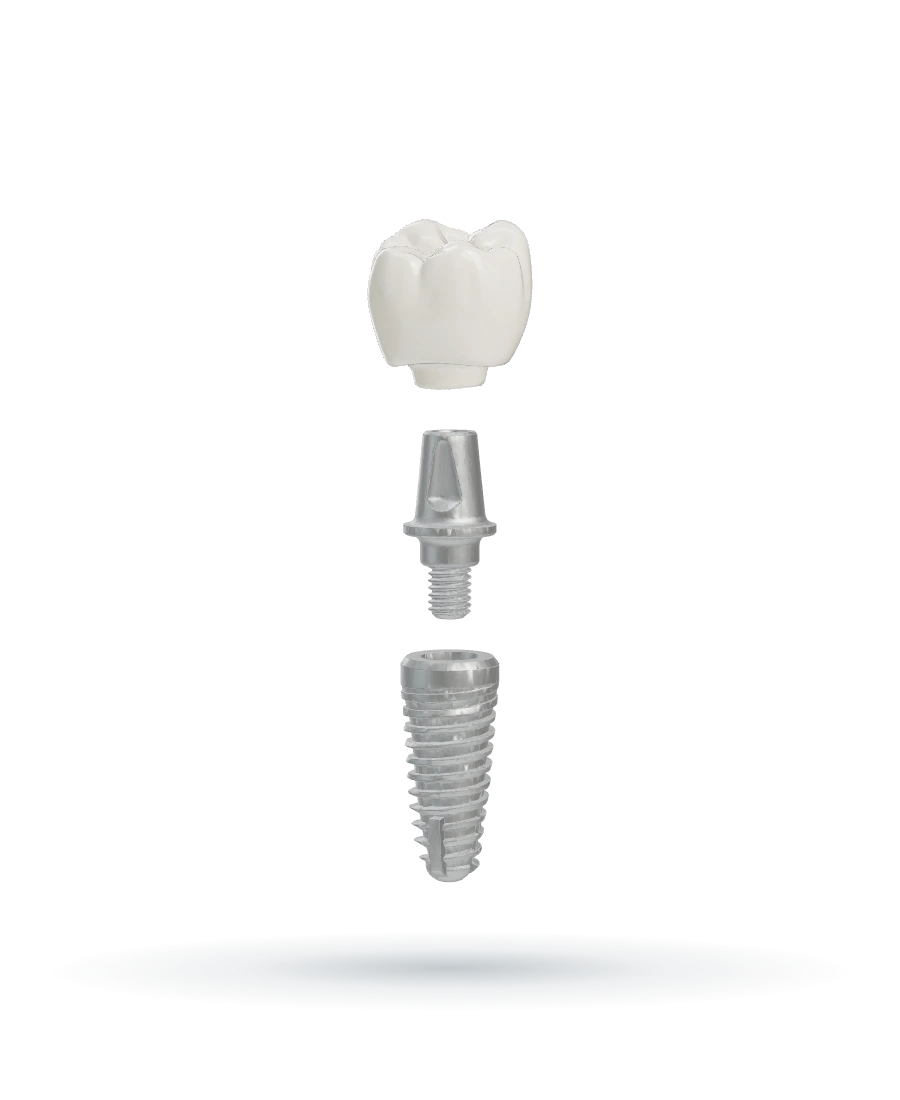
A dental implant has three parts. The implant is a small post in the jawbone that stands in for the root. The abutment is a connector that rises through the gum. The implant crown is the tooth-shaped cap on top, the only part you see when you smile or chew.
An implant crown differs from a regular crown in what holds it up. A regular crown covers a natural tooth that has been shaped to receive it. An implant crown has no tooth underneath. It is attached to the abutment with a small screw or with dental cement, and your dentist chooses the method that suits your case.
Each crown is made for one person and one position in the mouth. X-rays and a digital scan or an impression record the space, your bite and the neighboring teeth, so the crown can be shaped and shaded to sit comfortably beside them. At Dental Care of Ventura, implants are placed by Dr. Ori Levy, a board-certified periodontist.
Potential benefits
Fills the visible gap
A crown on an implant replaces the tooth you can see, which can help keep neighboring teeth from drifting into the space.
Made to match
Shape and shade are chosen with your other teeth in view, so the crown is designed to blend in with them.
Leaves neighboring teeth alone
The crown is supported by the implant, so the teeth on either side usually do not need to be reshaped to hold it.
Fixed, not removable
The crown stays in your mouth. You brush and clean around it daily, and many people find they can chew on that side again.
Who may be a candidate
An implant crown is the final stage of implant treatment, so the question is usually whether an implant suits you. That depends on an examination, X-rays and your health history.
- You are missing a tooth, or have a tooth that cannot be saved.
- You have an implant that has healed and is ready for its final crown.
- You have an older implant crown that is worn, chipped or loose and may need to be replaced.
- Your gums are healthy, or gum disease has been treated first.
- You grind or clench your teeth. Tell us, because heavy biting forces can affect how the crown is designed and protected.
What treatment typically involves
The crown is made after the implant has been placed and has had time to heal, and your own schedule is set at the consultation.
Consultation and planning
We examine your mouth, take X-rays and review your health history. If the tooth is still present, we talk through whether it can be saved before planning an implant.
Implant placement and healing
The implant is placed in the jawbone by Dr. Levy. Bone typically needs a few months to bond with it before a final crown is attached.
Scan or impression
Once the implant is stable, we record its position with a digital scan or an impression and choose a shade that matches your other teeth.
Making the crown
The crown is made to fit the recorded space and your bite. You may wear a temporary tooth while it is being made.
Fitting the crown
The abutment is connected to the implant and the crown is attached to it, either with a screw or with dental cement. We then check your bite and adjust it if needed.
Checkups and cleaning
An implant crown cannot decay, but the gum around it can become inflamed. Daily brushing, cleaning between the teeth and regular visits help protect it.
Recovery and aftercare
- Some pressure or tenderness in the gum is common for a short time after the crown is fitted, and it usually settles.
- If your bite feels high or uneven once you are home, call the office so it can be checked and adjusted.
- Brush twice a day and clean between your teeth daily, including where the crown meets the gum. Ask which cleaning aids suit your implant.
- Avoid chewing ice, hard candy and other very hard objects, which can chip the crown.
- If you grind or clench your teeth, ask your dentist how to protect the crown from those forces.
- Call the office if the crown feels loose or chips, or if the gum around it becomes swollen, sore or starts to bleed.
What affects the cost
We do not publish a price for implant crowns, because an honest figure depends on your own mouth. These are the things it depends on.
- How many implant crowns are being made.
- The material chosen for the crown.
- Whether the crown is held with a screw or with cement, and the abutment it needs.
- Whether you need a temporary tooth while the crown is made.
- What your dental insurance covers.
Questions to bring to your consultation
- Will my crown be held with a screw or with cement, and why?
- What material do you recommend for my crown, and how closely will it match my other teeth?
- Who will place the implant, and who will fit the crown?
- Will I have a temporary tooth while the implant heals?
- How should I clean around the crown at home?
- What happens if the crown chips or comes loose?
Common questions
What is the difference between an implant crown and a regular crown?
A regular crown fits over a natural tooth that has been shaped to hold it. An implant crown replaces a tooth that is missing altogether. It attaches to a connector on a dental implant, which takes the place of the root. From the outside the two can look very similar.
Is an implant crown screwed in or cemented?
It can be either. Some crowns are held by a small screw, and the opening for the screw is then sealed with tooth-colored filling material. Others are bonded to the abutment with dental cement. Each method has advantages, and your dentist will explain which one is planned for you and why.
Does having the crown fitted hurt?
Fitting the crown is usually a simpler visit than placing the implant, because the site has already healed. You may feel some pressure while the crown is seated and your bite is checked. If the gum is tender, the area can be numbed. Tell us if you are worried about discomfort so we can plan for it.
How long does an implant crown last?
There is no fixed lifespan. The crown takes the daily wear of chewing, so it may chip, loosen or wear down and need repair or replacement at some point, even when the implant underneath stays sound. Good home care, regular checkups and protecting your teeth from grinding can all help.
How do I look after an implant crown?
Brush twice a day and clean between your teeth daily, including where the crown meets the gum. Your dentist or hygienist may suggest floss made for implants, small interdental brushes or a water flosser. Regular checkups and cleanings let us look for early signs of inflammation around the implant.
Who provides implant crowns at Dental Care of Ventura?
Implant treatment here involves two dentists. Dr. Ori Levy, a board-certified periodontist, places the implant. Dr. Tannaz Askari, our general and cosmetic dentist, assesses your teeth and plans the crown with you. You will be told at your consultation who will carry out each stage of your own treatment.
Related care
- Dental ImplantsA titanium post that takes the place of a missing root and supports a custom crown, bridge or denture.
- Dental CrownsA custom cap that covers a damaged or weakened tooth to restore its shape and strength.
- Bone GraftingA procedure that adds bone or a bone substitute to the jaw, often to prepare for an implant.
- Dental BridgesA fixed restoration that replaces missing teeth by anchoring artificial teeth to neighboring teeth or implants.
- Tooth ExtractionsCareful removal of a tooth that cannot be saved, with a plan for healing and for replacing it.
Further reading
All journal articles- Dental Implants vs Dentures: How to ChooseMissing several or all of your teeth? Compare implants and dentures: how each feels, what it needs from your jaw and health, upkeep, time and cost.
- How Much Do Dental Implants Cost in Ventura?Why we give no price for a dental implant without an exam, what a treatment includes, what changes the cost, and how to compare quotes like for like.
- Dental Implant or Bridge: How to ChooseMissing one tooth? Compare a dental implant with a bridge: what each involves, how long treatment takes, how you care for it, and what to ask your dentist.
- How Long Does a Dental Implant Take?A dental implant commonly takes several months from first visit to final crown. See each stage, what adds time, and what happens while the site heals.
- How to Care for Dental ImplantsHow to look after a dental implant: daily cleaning, habits that put it at risk, warning signs to have checked and what happens at maintenance visits.
- Your First Dental Implant ConsultationWhat happens at a first dental implant consultation: what to bring, the health questions, the exam and X-rays, how suitability is judged, and what comes next.
Talk it through with a dentist.
Tell us what you would like to talk about and we will reply within one business day to arrange a time.