Full-Arch Implants in Ventura, California
A whole arch of teeth, supported by implants.
Full-arch implant treatment replaces all the teeth in the upper or lower jaw with a set of teeth held in place by several dental implants. It is one alternative to a conventional removable denture. At our Ventura office, your dentist will explain whether it suits you.
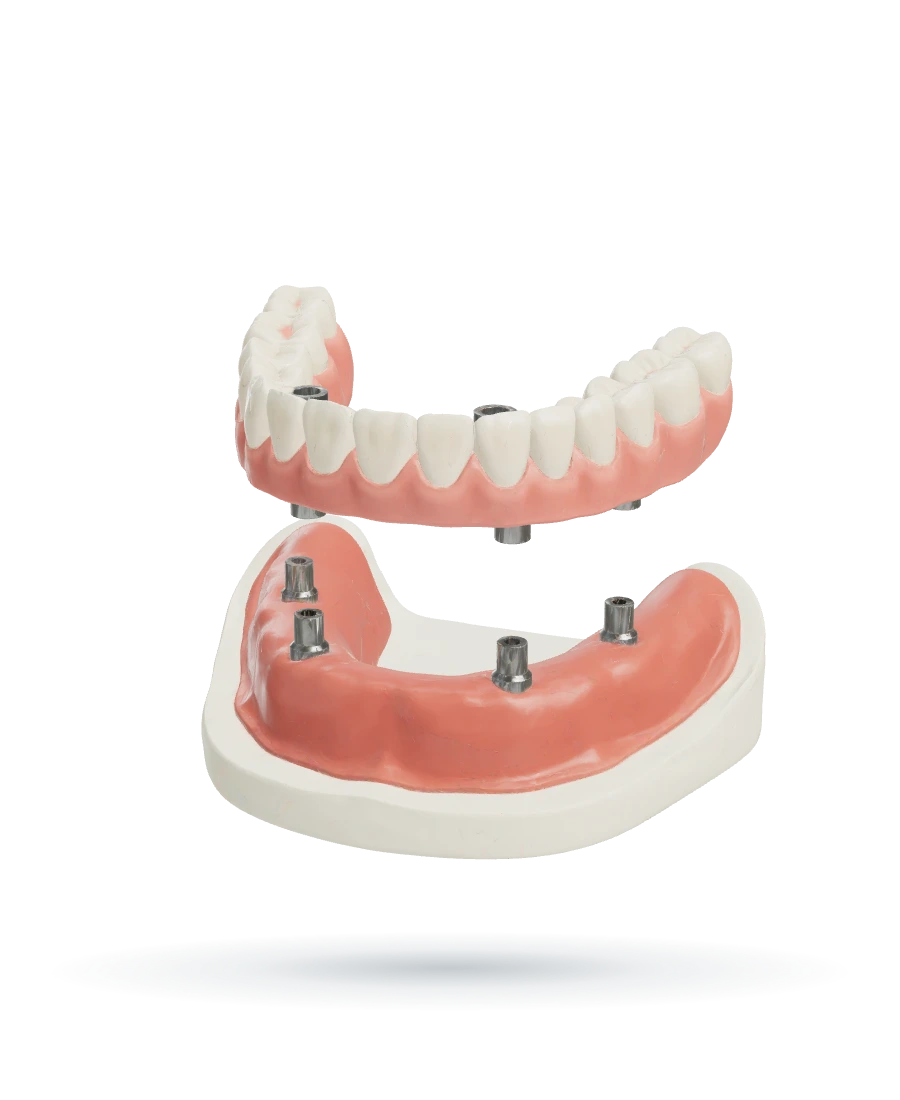
What it is
When all or nearly all the teeth in one jaw are missing, or cannot be saved, a full arch of replacement teeth can be attached to several implants placed in the jawbone. The implants act as anchors in place of tooth roots. The number needed varies with the jaw, the bone and the type of teeth planned. It is often four to six in each jaw, but your dentist will advise on your case.
There are two general types. A fixed full-arch set, sometimes called an implant-supported bridge, is attached to the implants and is not taken out at home. An implant-retained denture, sometimes called an overdenture, clips onto attachments on the implants. It is usually steadier than a denture that rests on the gums alone, and you take it out each day to clean it. It may need fewer implants than a fixed set.
Treatment is planned in stages. Depending on your mouth, it can include removing teeth that cannot be kept, bone grafting where bone is thin, placing the implants, a period of healing with a temporary set of teeth, and fitting the final teeth. Your dentist will explain which type suits you, the stages in your plan and how long each is likely to take.
Potential benefits
Teeth that stay steady
A fixed set stays in place, and an implant-retained denture is usually steadier than one that rests on the gums alone. Many people find this makes eating and speaking easier.
A full arch on several implants
A whole arch can be supported by a limited number of implants, so one is not usually needed for every missing tooth.
Support for the jawbone
Bone tends to shrink after teeth are lost. Implants pass chewing forces into the jaw, which can help slow that change.
Less coverage of the palate
A fixed upper set usually does not cover the roof of your mouth, as a conventional upper denture does.
Who may be a candidate
Full-arch implants may be considered when most or all of the teeth in one jaw are missing or cannot be saved. Whether they suit you depends on an examination, imaging and your medical history.
- You are missing all or most of the teeth in your upper or lower jaw, or both.
- The teeth you still have in one jaw are failing and cannot be saved.
- You wear a full denture that is loose or uncomfortable and would like something more stable.
- There is enough bone for implants, or you are open to bone grafting to build it up.
- Any gum disease around remaining teeth has been treated, or will be treated as part of the plan.
- Smoking, diabetes that is not well controlled and some medications can affect healing. Tell us about them so we can plan around them.
What treatment typically involves
Full-arch treatment happens in stages, with healing time between them. Your own sequence and timeline are set at the consultation.
Consultation and imaging
We examine your mouth, take X-rays and any other imaging your case needs, review your health history and talk through every option, including a conventional denture.
Planning your new teeth
Records such as impressions or a digital scan, and measurements of how your jaws meet, may be taken to plan where the implants go and the shape of the new teeth.
Extractions and grafting
Teeth that cannot be kept are removed. Where bone is thin, a graft may be placed, sometimes at the same visit and sometimes as a separate stage.
Placing the implants
With the area numbed, the implants are positioned in the jawbone and the gum is closed around them.
Healing with temporary teeth
Bone bonds to the implants over a period that is typically a few months. You wear a temporary set in the meantime, which may be attached to the implants or may be a removable denture.
Final teeth and ongoing care
Once the implants are stable, the final set is made, fitted and your bite adjusted. Daily cleaning and regular checkups then help protect the implants and the gum around them.
Recovery and aftercare
Recovery after full-arch surgery is gradual. Follow the instructions you are given, and use this as a general guide.
- Soreness, swelling and some bruising are common for several days. A cold pack used as directed and pain relief as advised by your dentist can help.
- Follow the diet you are given. Soft foods are usually advised while the implants heal, even with temporary teeth in place. Avoid hard or chewy foods until you are told otherwise.
- Keep your mouth clean as instructed, rinsing and brushing gently around the surgical areas.
- Avoid smoking while you heal, since it can affect how well the bone bonds to the implants.
- Attend your follow-up visits, and call the office sooner if pain, swelling or bleeding gets worse instead of better, or if a temporary tooth feels loose.
- Once the final teeth are fitted, clean around and under them every day and keep regular checkups, because the gum and bone around implants can become inflamed.
What affects the cost
We do not publish a price for full-arch implants, because an honest figure depends on your own mouth. These are the things it depends on.
- Whether one jaw or both are treated, and how many implants each needs.
- Whether the teeth will be a fixed set or an implant-retained denture, and the materials used.
- Whether extractions or bone grafting are needed first.
- The imaging, planning and temporary teeth your case needs.
- What your dental insurance covers.
Questions to bring to your consultation
- Would a fixed set or an implant-retained denture suit me better, and why?
- How many implants would my case need, and would I need extractions or bone grafting first?
- What will I wear while the implants heal, and when can it be fitted?
- How long is treatment likely to take from start to finish, and how many visits will it involve?
- Which parts of my treatment take place at your office, and who will carry them out?
- What does the full cost include, and what might my insurance cover?
Common questions
How is this different from a regular denture?
A conventional denture rests on the gums and is held by its fit against them, so it can move, especially in the lower jaw. Full-arch teeth are held by implants in the bone. A fixed set stays in place, and an implant-retained denture clips onto the implants for added stability. Implant treatment involves surgery and healing time, which a conventional denture does not.
How many implants are needed?
It varies. A full arch is often supported by about four to six implants, but the number depends on the jaw, the amount and quality of bone, and whether the teeth will be fixed or removable. An implant-retained denture may need fewer. Your dentist will recommend a number after examining you and reviewing your imaging.
Will I have teeth while the implants heal?
A temporary set of teeth is usually planned for the healing period. Whether it can be attached to the implants soon after they are placed depends on how firmly they are held in the bone, the condition of your jaw and your treatment plan, and it is not possible for everyone. Some people wear a removable denture while the implants heal. Your dentist will explain what to expect.
Does treatment hurt?
The area is numbed with local anesthetic, so most people describe pressure rather than pain while the implants are placed. Soreness, swelling and bruising are common for several days afterward. We have nitrous oxide, oral sedation and IV sedation in the office. Whether any of these suits you depends on your health and the treatment planned, and your dentist can talk this through with you.
How long do full-arch implants last?
There is no fixed lifespan. Many implants stay in service for many years with good home care and regular checkups, but results vary from person to person. The teeth attached to them wear with use and may need repair or replacement over time, and the gum and bone around implants can become inflamed if they are not kept clean.
How do I clean full-arch teeth?
A fixed set is cleaned in place every day, including underneath where it meets the gum, using the cleaning aids your dental team recommends. An implant-retained denture is taken out and cleaned daily, and the attachments on the implants are cleaned too. Regular professional cleanings and checkups are part of looking after both.
Related care
- Dental ImplantsA titanium post that takes the place of a missing root and supports a custom crown, bridge or denture.
- DenturesRemovable full or partial dentures that replace several or all of your teeth.
- Bone GraftingA procedure that adds bone or a bone substitute to the jaw, often to prepare for an implant.
- Full Mouth ReconstructionA staged plan that combines several restorative treatments to rebuild worn, damaged or missing teeth throughout the mouth.
Further reading
All journal articles- Dental Implants vs Dentures: How to ChooseMissing several or all of your teeth? Compare implants and dentures: how each feels, what it needs from your jaw and health, upkeep, time and cost.
- How Much Do Dental Implants Cost in Ventura?Why we give no price for a dental implant without an exam, what a treatment includes, what changes the cost, and how to compare quotes like for like.
- Your First Dental Implant ConsultationWhat happens at a first dental implant consultation: what to bring, the health questions, the exam and X-rays, how suitability is judged, and what comes next.
- Dental Implant or Bridge: How to ChooseMissing one tooth? Compare a dental implant with a bridge: what each involves, how long treatment takes, how you care for it, and what to ask your dentist.
- Do You Need a Bone Graft Before an Implant?Not every implant needs a bone graft. Learn why bone matters, when a graft is recommended, the main types, how recovery goes and how much time it adds.
- How Long Does a Dental Implant Take?A dental implant commonly takes several months from first visit to final crown. See each stage, what adds time, and what happens while the site heals.
Talk it through with a dentist.
Tell us what you would like to talk about and we will reply within one business day to arrange a time.