Guided Tissue Regeneration in Ventura, California
Helping the body rebuild support around a tooth.
Guided tissue regeneration is a procedure that helps the body regrow bone and attachment lost to gum disease around a tooth. It is usually done during gum surgery, using a thin barrier membrane and often graft material. Results vary, and your dentist will explain whether your case suits it.
What it is
Gum disease destroys the bone and the fine fibers that attach a tooth to it, and bone that has been lost does not grow back on its own. Deep cleaning and osseous surgery aim to bring the disease under control and reduce the pockets where bacteria collect. Guided tissue regeneration aims to go a step further and help some of the lost support grow back.
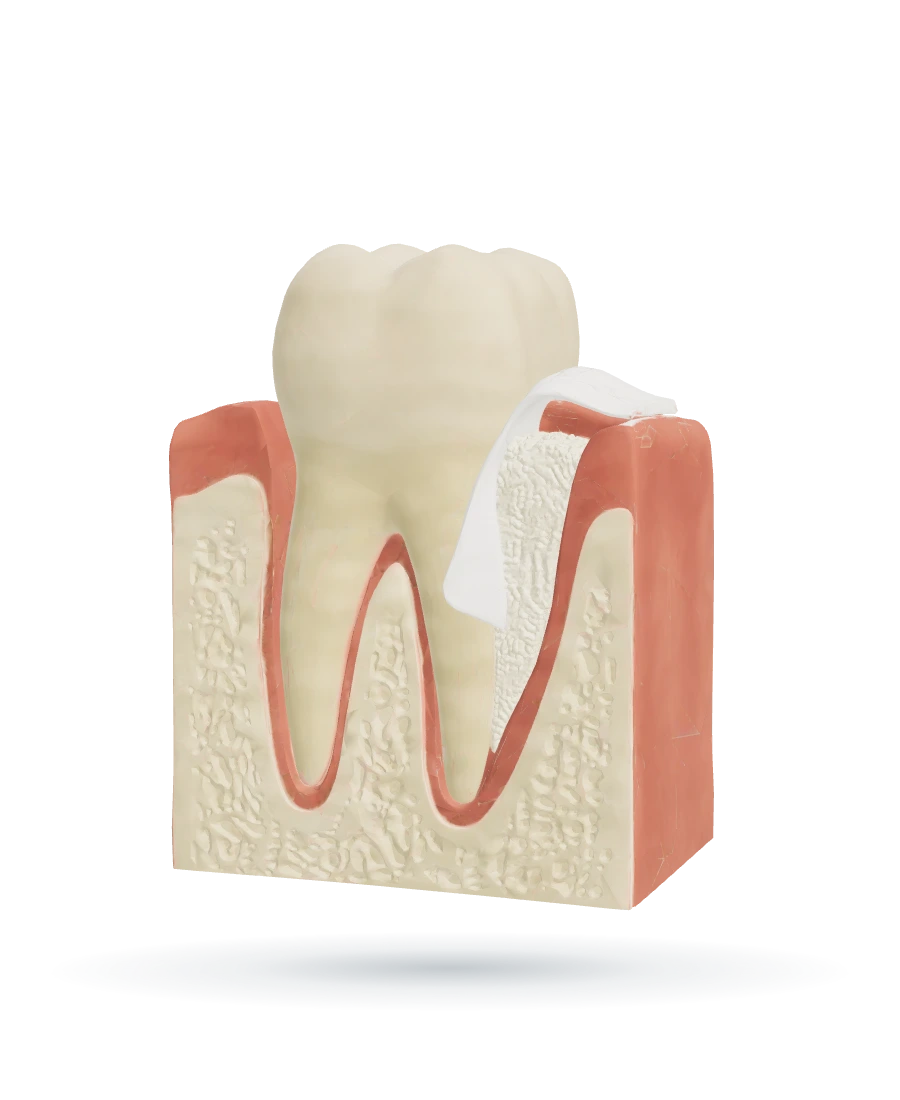
After the roots are cleaned, the gum tends to heal faster than bone and can fill the space first. In guided tissue regeneration, a thin barrier membrane is placed over the defect in the bone, often with bone graft material beneath it. The membrane holds the gum away from the space so that bone and attachment, which grow more slowly, have the chance to fill it. Some membranes dissolve on their own, and others are removed at a later visit.
It suits some defects better than others. It is generally better suited to a deep, narrow area of bone loss beside a tooth, or to some areas between the roots of back teeth, than to bone lost evenly across several teeth. Results also vary with your general health and habits, smoking in particular, and with how well the area is kept clean afterward.
Potential benefits
May regrow lost support
In suitable defects, the procedure can help some of the bone and attachment lost to gum disease grow back around the tooth.
Shallower gum pockets
Filling a defect can reduce pocket depth, leaving fewer places for bacteria to collect and making the area easier to keep clean.
Helps keep natural teeth
Rebuilding support may improve the outlook for a tooth that would otherwise be at risk.
Who may be a candidate
Guided tissue regeneration is considered for people whose gum disease has left a particular kind of bone defect around one or more teeth. Whether it suits you is decided after a periodontal examination and X-rays.
- Gum measurements and X-rays show a deep, narrow area of bone loss beside a tooth.
- A back tooth has lost some of the bone between its roots.
- Your gum disease has first been brought under control with deep cleaning and good home care.
- You are able to keep up daily cleaning and regular maintenance visits afterward, which the result depends on.
- Smoking and diabetes that is not well controlled can reduce how well the area regenerates. Tell us about these, and about any regular medications, before treatment is planned.
What treatment typically involves
The procedure is usually planned after the gums have been re-evaluated following a deep cleaning.
Periodontal evaluation
Your gums are measured, X-rays are reviewed and your health history is checked. Your dentist explains the shape of the defect and your options, regenerative and otherwise.
Numbing the area
Local anesthetic is used to numb the section of the mouth being treated before the procedure begins.
Cleaning the defect
The gum is folded back from the tooth. Tartar and infected tissue are removed from the root and from the defect in the bone.
Placing the graft and membrane
Bone graft material is often placed in the defect. A thin barrier membrane is then fitted over it, against the tooth.
Closing the gum
The gum is placed back over the membrane and secured with stitches. You are given instructions for the first days at home.
Healing and maintenance
Stitches are removed or dissolve as the gum heals, and a membrane that does not dissolve is removed at a later visit. The area is checked with measurements and X-rays over the following months, and regular periodontal maintenance visits follow.
Recovery and aftercare
The membrane and any graft need to stay undisturbed while the gum heals over them. You will be given instructions for the first days at home. These general points add to them and do not replace them.
- Rest for the remainder of the day. Swelling and soreness are common for several days, and a cold pack and pain relief as advised by your dentist can help.
- Eat soft foods and chew away from the treated area until you are told it is safe to do otherwise.
- Clean the treated area only as directed, which may mean not brushing there for a time, and do not pull your lip or cheek aside to look at the site.
- You may notice a few small, sand-like particles of graft material in the first days. Call the office if you notice a lot of them, or if you can see the membrane through the gum.
- Do not smoke while you heal, since smoking can slow healing and reduce how well the area regenerates.
- Keep your follow-up and maintenance visits, and call the office if bleeding, swelling or pain gets worse instead of better, if the gum opens over the site or if you develop a fever.
What affects the cost
We do not publish a price for guided tissue regeneration, because an honest figure depends on your own mouth. These are the things it depends on.
- How many teeth or areas are treated.
- Whether graft material is used with the membrane, and the type of membrane.
- Whether a later visit is needed to remove the membrane.
- The X-rays, follow-up and maintenance visits needed afterward.
- What your dental insurance covers.
Questions to bring to your consultation
- Is the bone loss around my tooth the kind that may respond to regeneration?
- What result is realistic for this tooth, given my health and habits?
- Will you use graft material, and will the membrane dissolve or need to be removed later?
- How does this compare with osseous surgery or other options for my case?
- What will recovery involve, and when will you be able to tell how it has healed?
- What will this cost, and what might my insurance cover?
Common questions
How is guided tissue regeneration different from osseous surgery?
Osseous surgery reshapes the bone to reduce pockets, so that they are easier to keep clean. Guided tissue regeneration aims to help lost bone and attachment grow back into a defect. Both begin by folding back the gum and cleaning the roots, and they can be used in different areas of the same mouth. Your dentist will explain which suits each area.
How is it different from a bone graft for an implant?
Both can use graft material and a membrane. Guided tissue regeneration is done around a natural tooth to rebuild its support. A bone graft for an implant rebuilds bone where a tooth is missing, so that an implant can be placed there. A similar membrane technique used at implant sites is often called guided bone regeneration.
Does guided tissue regeneration hurt?
The area is numbed with local anesthetic, so most people feel pressure rather than pain during the procedure. Soreness and swelling afterward are common for several days and are usually managed with pain relief as your dentist advises. If you feel nervous about treatment, tell us. The office has nitrous oxide, oral sedation and IV sedation, and your dentist can tell you whether any of them may suit you.
Does it always work?
No. How much bone and attachment grow back varies from person to person and from one defect to another. Deep, narrow defects tend to respond better than wide, shallow ones. Smoking, diabetes that is not well controlled and plaque left on the area can all reduce the result. The area is checked over the following months to see how it has healed.
What is the membrane made of?
Membranes are thin sheets of material that the body tolerates well. Some, often made of collagen, dissolve gradually as the area heals, so they do not need to be removed. Others are made of synthetic materials that stay in place until they are taken out at a later visit. Your dentist will explain which is recommended for you.
When will I know how it has healed?
The gum usually settles within a few weeks, but bone fills in slowly. It commonly takes several months before measurements and X-rays show how the area has responded. Your dentist will tell you when it will be checked.
Related care
- Osseous SurgerySurgery that reduces deep gum pockets and reshapes damaged bone so advanced gum disease is easier to control.
- Bone GraftingA procedure that adds bone or a bone substitute to the jaw, often to prepare for an implant.
- Scaling and Root PlaningA non-surgical deep cleaning that removes plaque and tartar from below the gumline to treat gum disease.
- Periodontal CareAn overview of how gum disease is found and treated, from deep cleaning to surgery, by a board-certified periodontist.
Further reading
All journal articles- Receding Gums: Causes and TreatmentReceding gums expose the tooth root and do not grow back. Learn the common causes, how to keep recession from getting worse and which treatments may help.
- What Does a Periodontist Do?A periodontist is a dentist with extra training in the gums and bone that support teeth. Learn what they treat, when you may be referred and what to expect.
- How Much Do Dental Implants Cost in Ventura?Why we give no price for a dental implant without an exam, what a treatment includes, what changes the cost, and how to compare quotes like for like.
- Your First Dental Implant ConsultationWhat happens at a first dental implant consultation: what to bring, the health questions, the exam and X-rays, how suitability is judged, and what comes next.
- Do You Need a Bone Graft Before an Implant?Not every implant needs a bone graft. Learn why bone matters, when a graft is recommended, the main types, how recovery goes and how much time it adds.
- Early Signs of Gum DiseaseBleeding, red or puffy gums and lasting bad breath can be early signs of gum disease. Learn what to look for, who is at risk and when to see a dentist.
Talk it through with a dentist.
Tell us what you would like to talk about and we will reply within one business day to arrange a time.