Inlays and Onlays in Ventura, California
A middle step between a filling and a crown.
An inlay or onlay is a custom-made restoration that repairs a tooth, usually a back tooth, when the damage is too large for a filling but the tooth does not need a full crown. At our Ventura office, your dentist will explain whether one suits your tooth.
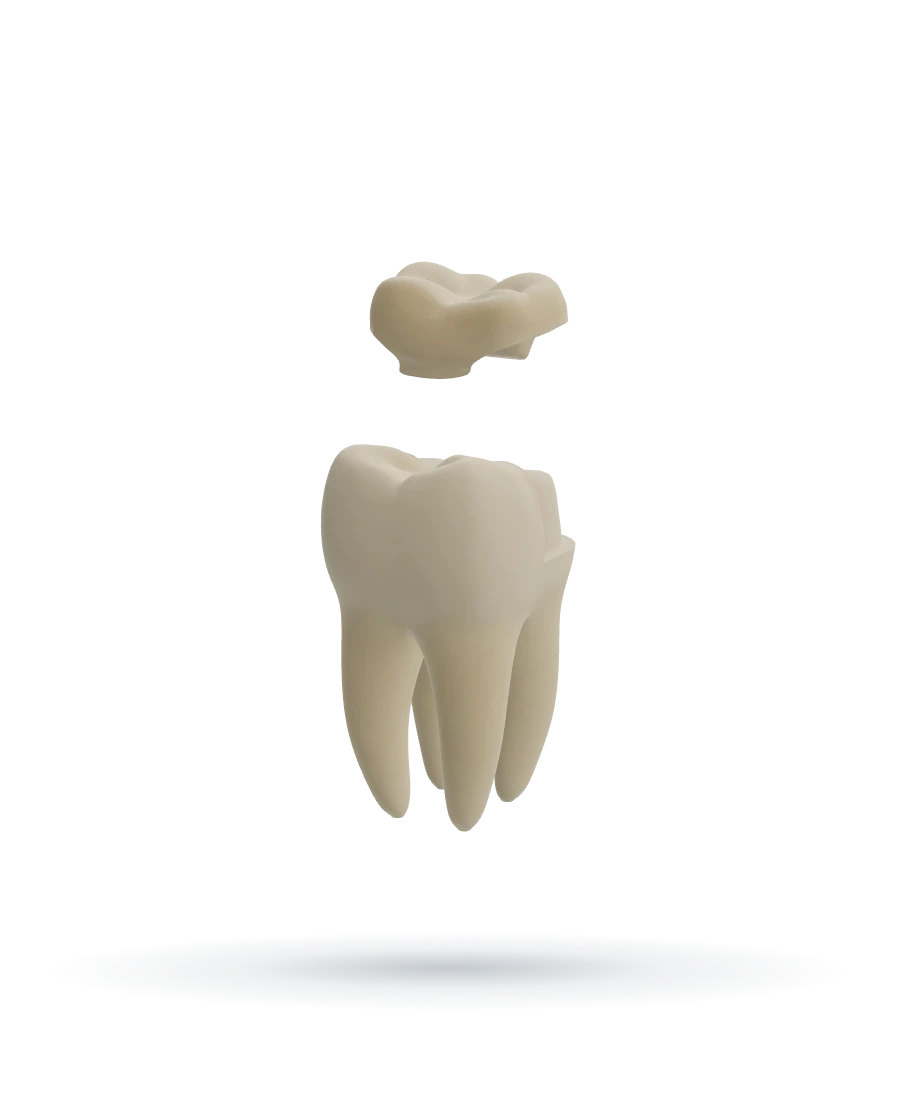
What it is
Inlays and onlays are sometimes called indirect restorations, because they are made outside the mouth to fit the prepared tooth instead of being shaped directly in it like a filling. They are generally used on back teeth, where a large cavity, a broken cusp or a failing old filling has left more damage than a standard filling can repair well.
The difference between the two is how much of the tooth they cover. An inlay sits within the chewing surface, between the raised points called cusps. An onlay extends over one or more of the cusps and is sometimes called a partial crown. A crown covers the whole visible tooth, so an inlay or onlay can often keep more of your natural tooth in place.
Inlays and onlays can be made from porcelain or other ceramics, from composite resin or from gold. Tooth-colored materials are bonded to the tooth, and gold is usually cemented. The right choice depends on the size and position of the damage, your bite and how much the restoration will show. Your dentist will explain the options for your tooth.
Potential benefits
Conserves tooth structure
An inlay or onlay usually needs less healthy tooth to be removed than a full crown, because it covers only the damaged part.
Support for a weakened tooth
By covering one or more cusps, an onlay can help hold a weakened tooth together and may lower the chance of a cusp breaking.
Suited to larger repairs
Because it is made in one piece outside the mouth, an inlay or onlay may stand up to chewing better than a very large filling would.
Can blend with your tooth
Porcelain and composite are matched to the shade of your tooth, so a tooth-colored inlay or onlay is usually hard to notice.
Who may be a candidate
An inlay or onlay may be suggested when a tooth has more damage than a filling can repair well, but enough healthy structure remains that a full crown is not needed. An examination and X-rays show which repair suits the tooth.
- A back tooth has a large cavity, or decay under or around an old filling.
- An existing filling is large, cracked or worn and needs to be replaced.
- A cusp has chipped or broken off, or has been weakened by a large filling.
- You would like to keep as much of your natural tooth as possible, and the tooth is suitable for it.
- The tooth has enough healthy structure left to support one. If not, a crown may be discussed instead.
- You grind or clench your teeth. Tell us, because heavy biting forces can affect which material and design are suitable.
What treatment typically involves
An inlay or onlay usually takes more than one visit, because it is made to fit the tooth after the tooth has been prepared.
Examination and X-rays
Your dentist examines the tooth and reviews X-rays to see how far the damage goes, then explains whether a filling, an inlay, an onlay or a crown suits it.
Preparing the tooth
With the area numbed, decay and any old filling material are removed, and the tooth is shaped so the restoration can fit closely.
Recording the tooth
The prepared tooth and your bite may be recorded with a digital scan or an impression. For a tooth-colored restoration, a shade is chosen to match the tooth.
Temporary restoration
A temporary is usually placed to protect the tooth while the inlay or onlay is being made. Avoid sticky or hard foods on that side until it is replaced.
Fitting the inlay or onlay
At a later visit the temporary is removed and the inlay or onlay is tried in. Fit, bite and color are checked, then it is bonded or cemented in place and polished.
Care afterward
Brush and clean between your teeth as usual. The edge where the restoration meets the tooth can still decay, so regular checkups matter.
Recovery and aftercare
Recovery after each visit is usually short, but a few points help in the first days.
- Wait until the numbness has fully worn off before you eat or have hot drinks, so you do not bite or burn your lip, cheek or tongue.
- With a temporary in place, chew on the other side and avoid sticky or hard foods. When flossing, slide the floss out sideways rather than lifting it up.
- Some sensitivity to cold or biting pressure is common for a short time after each visit and usually settles. Pain relief as advised by your dentist can help.
- If your bite feels high or uneven once the inlay or onlay is in, call the office so it can be checked and adjusted.
- Brush twice a day and clean between your teeth daily, paying attention to the edges of the restoration, and keep your regular checkups.
- Avoid chewing ice, pens or other hard objects, and call us if the restoration feels rough, loose or cracked.
What affects the cost
We do not publish a price for inlays and onlays, because an honest figure depends on your own mouth. These are the things it depends on.
- How many teeth need treatment, and how much of each tooth is involved.
- Whether an inlay or an onlay is needed, and how many surfaces it covers.
- The material chosen, such as porcelain, composite or gold.
- Whether other treatment is needed first.
- What your dental insurance covers.
Questions to bring to your consultation
- Is this tooth better suited to a filling, an inlay, an onlay or a crown, and why?
- Which material do you recommend for this tooth, and why?
- How much of my natural tooth will need to be removed?
- How many visits will it take, and what will be on the tooth in between?
- How long is a restoration like this likely to last, and what could shorten its life?
- What will this cost, and what might my insurance cover?
Common questions
What is the difference between an inlay and an onlay?
Both are made outside the mouth and fitted to a prepared tooth. An inlay sits within the chewing surface, between the cusps. An onlay extends over one or more cusps, which can help protect a tooth that has lost part of its biting edge. Your dentist chooses between them based on where the damage is and how much of the tooth is sound.
How is an onlay different from a crown?
A crown covers the whole visible part of the tooth, down to the gum line, so the tooth is shaped on all sides to make room for it. An onlay covers only the damaged area and the cusps that need support, so more of the natural tooth can often be kept. When a tooth is very weak or badly broken, a crown may still be the sounder choice.
Does getting an inlay or onlay hurt?
The tooth is numbed with local anesthetic before it is prepared, so most people feel pressure and vibration rather than pain. The tooth may be sensitive to cold or biting for a few days after each visit. If you feel anything sharp during treatment, tell your dentist so more anesthetic can be given.
How long do inlays and onlays last?
There is no fixed lifespan. How long one lasts depends on the material, the size and position of the restoration, your bite and how well the tooth is kept clean. Grinding, chewing hard objects and decay at the edges are common reasons one needs attention sooner. They are checked at each exam so that wear or leakage can be dealt with early.
Which material is right for me?
It depends on the tooth. Porcelain and composite are tooth-colored and are often chosen where appearance matters. Gold is strong, tends to cause little wear on the opposing teeth and is sometimes chosen for back teeth that take heavy biting forces. Your bite, any grinding habit and your own preferences also matter. Your dentist will explain the options for your tooth.
What should I do if my temporary comes off?
Keep the temporary and call the office. It protects the prepared tooth and holds its shape, so it should be put back promptly. Until you are seen, avoid chewing on that side and keep the area clean. Do not use household glue. We will advise you on what to do in the meantime.
Related care
- Dental FillingsA repair that replaces decayed tooth structure with a durable material, most often tooth-colored composite.
- Dental CrownsA custom cap that covers a damaged or weakened tooth to restore its shape and strength.
- Restorative DentistryAn overview of how damaged teeth are rebuilt and missing teeth replaced, from a single crown to a full plan.
- General DentistryExams, cleanings and preventive care that help find and treat dental problems while they are still small.
Further reading
All journal articles- Crown or Filling: What Decides It?Crown or filling? It depends on how much healthy tooth is left. See what dentists consider, when each is used, the trade-offs and the questions to ask.
- How Cavities Form and How Fillings Fix ThemHow tooth decay starts, the stages a cavity goes through, why early cavities rarely hurt, and what happens step by step when a dentist places a filling.
- Sensitive Teeth: Causes and What HelpsSensitive teeth are usually caused by exposed dentin from worn enamel or receding gums. Learn the causes, what helps at home and when to see a dentist.
- Cracked Tooth: Signs and Treatment OptionsPain when you bite or release can mean a cracked tooth. Learn the signs, the types of crack, how each is treated and what to do until you are seen.
- Veneers, Bonding or Crowns: Which Fits?Bonding, porcelain veneers and crowns all change how a tooth looks, but they suit different problems. Compare what each involves and when it fits.
- What Happens During a Root CanalA step-by-step look at root canal treatment: why a tooth needs it, what happens in the chair, how it feels, recovery and why a crown often follows.
Talk it through with a dentist.
Tell us what you would like to talk about and we will reply within one business day to arrange a time.